This article is for informational purposes only. Please consult HMRC or a qualified accountant for specific IR35 advice.
The security industry in the UK has always operated in a complex regulatory environment. From SIA licensing requirements to health and safety obligations, security companies have long navigated multiple layers of compliance. However, 2025 has brought perhaps the most significant regulatory challenge yet: the comprehensive overhaul of IR35 rules.
The Off-Payroll Working regulations, commonly known as IR35, have been completely transformed this year. What started as tax legislation has evolved into a comprehensive framework that’s reshaping how security companies operate, hire staff, and manage their operations.
For security businesses across the UK, these changes aren’t just about tax compliance anymore. They’re about fundamental business model transformation, operational restructuring, and competitive repositioning in an industry that’s already facing significant challenges.
Understanding IR35: What It Means for Security Companies
IR35 rules determine whether a contractor should be treated as an employee for tax purposes. The legislation was originally designed to prevent tax avoidance through the use of intermediary companies. However, the 2025 reforms have expanded its scope dramatically.
The Traditional Security Industry Model
Historically, the security industry has relied heavily on flexible staffing models. Many companies used a mix of:
- Directly employed security officers
- Self-employed contractors for mobile patrols
- Subcontracted services for specialist roles
- Temporary staff through agencies
This model worked well for an industry characterised by:
- Unpredictable demand patterns
- 24/7 operational requirements
- Seasonal variations in security needs
- Cost-sensitive client requirements
How 2025 Changed Everything
The Enhanced Off-Payroll Working Act 2025 has fundamentally altered this landscape. The key changes affecting security companies include:
Universal application means all businesses, regardless of size, must now make IR35 determinations. Previously, smaller security companies could leave this responsibility to contractors. This exemption has been completely eliminated.
Mandatory assessments are now required for all contractor engagements exceeding £600 per day or £3,000 per month. For security companies, this covers most mobile patrol officers, specialist security consultants, and temporary supervisory roles.
Criminal penalties have been introduced for deliberate non-compliance. Security company directors now face potential imprisonment for systematic IR35 avoidance. This represents a dramatic escalation from previous civil penalties.
Real-time monitoring requirements mean that IR35 status must be continuously assessed based on actual working practices, not just contractual arrangements. This is particularly challenging for security companies where working relationships can evolve rapidly.
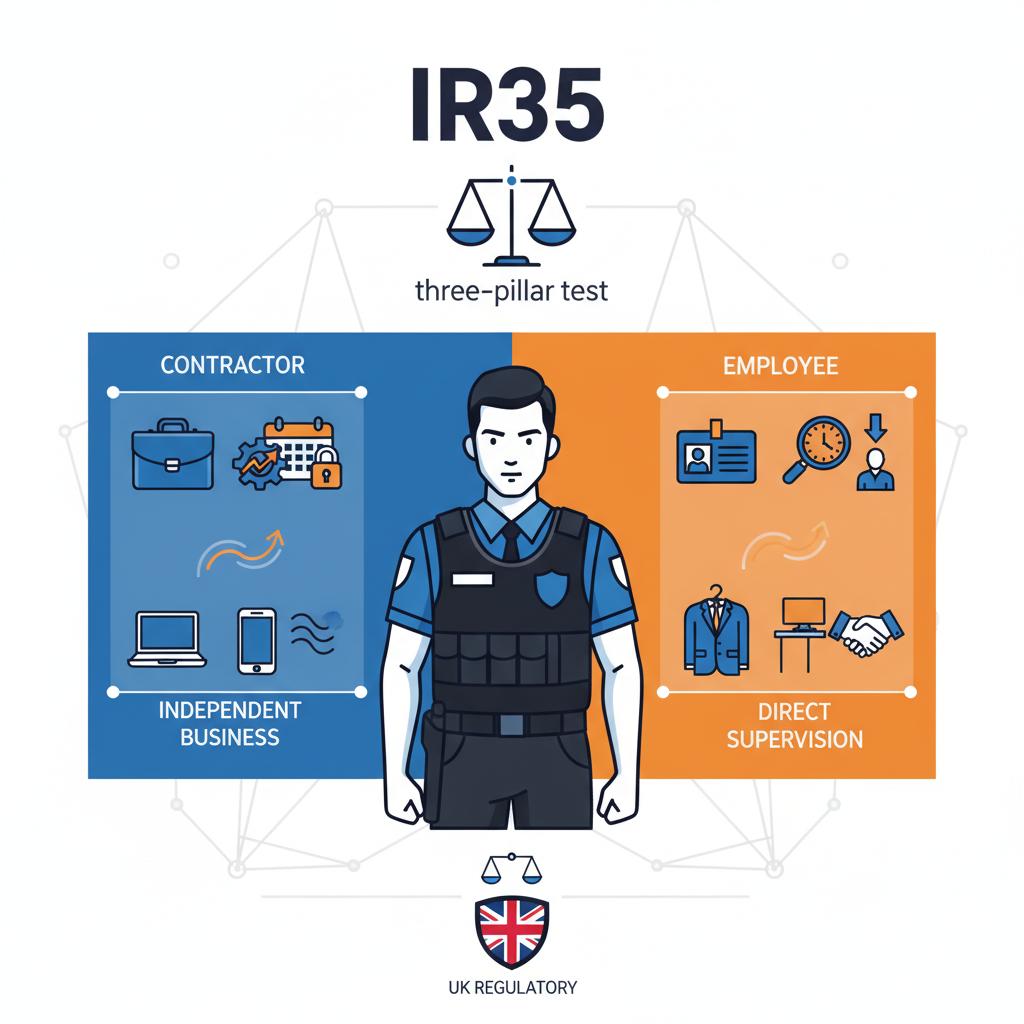
The Three-Pillar Test: How It Applies to Security Roles
The enhanced IR35 assessment uses three main criteria to determine worker status. Understanding how these apply to common security roles is crucial for compliance.
Control
The control test examines who has the right to control what work is done, when, where, and how it’s performed.
Traditional security officers employed directly by companies clearly fail this test for self-employment. They:
- Follow specific patrol routes and schedules
- Use company-provided equipment and uniforms
- Report to supervisors and follow company procedures
- Cannot substitute themselves with other workers
Mobile patrol contractors present a more complex picture. Those who genuinely operate independently might pass the control test if they:
- Set their own routes and methods (within client requirements)
- Use their own vehicles and equipment
- Have genuine flexibility in how they deliver services
- Can work for multiple clients simultaneously
Specialist consultants in areas like security risk assessment or system design are more likely to pass the control test if they:
- Have genuine expertise that clients cannot direct
- Use their own methodologies and tools
- Deliver defined outcomes rather than time-based services
- Maintain professional independence in their recommendations
Substitution
The substitution test examines whether contractors have the genuine right to send someone else to do the work.
For security roles, this test is particularly challenging because:
- SIA licensing requirements mean substitutes must have appropriate qualifications
- Client sites often require specific vetting and clearances
- Insurance and liability considerations limit substitution options
- Many security contracts specify named individuals
Genuine substitution rights in security work are rare but might exist where:
- Contractors maintain a pool of qualified, vetted substitutes
- Clients accept any appropriately qualified individual
- The contractor bears the cost and responsibility for substitutes
- Substitution can occur without client approval
Mutuality of Obligation
This test examines whether there’s an ongoing relationship with mutual obligations beyond individual assignments.
Traditional employment relationships clearly demonstrate mutuality of obligation through:
- Ongoing contracts with notice periods
- Regular work patterns and guaranteed hours
- Employee benefits and training provision
- Disciplinary and grievance procedures
Genuine contractor relationships lack mutuality of obligation and feature:
- Project-based or assignment-specific contracts
- No guarantee of future work
- Payment only for work actually performed
- No employee benefits or training obligations
Industry-Specific Challenges
The security industry faces unique challenges in implementing IR35 compliance due to its operational characteristics and regulatory environment.
SIA Licensing Complications
The Security Industry Authority licensing system creates additional complexity for IR35 assessments:
Licensed individuals must meet specific training and vetting requirements regardless of their employment status. This creates a professional framework that can support genuine self-employment but also limits flexibility in contractor arrangements.
Approved contractor schemes require security companies to maintain certain standards and procedures. These requirements can inadvertently create employment-like relationships with contractors who must follow company procedures to maintain compliance.
Continuous professional development requirements mean that security companies often invest in training for both employees and contractors. This investment can indicate an employment relationship under IR35 rules.
24/7 Operational Requirements
Security services often require continuous coverage, creating challenges for contractor arrangements:
Shift patterns that mirror employee schedules can indicate employment relationships, particularly where contractors work regular hours or participate in rotation systems.
Emergency response requirements may require contractors to be available outside normal working hours, potentially indicating mutuality of obligation.
Handover procedures between shifts can create supervision and control relationships that suggest employment rather than genuine contracting.
Client Requirements and Expectations
Security clients often have specific requirements that can complicate IR35 assessments:
Site-specific training requirements may create investment in contractors that suggests employment relationships.
Uniform and equipment standards specified by clients can limit contractor independence and suggest employment.
Reporting and communication protocols may create supervision relationships that indicate employment status.
Technology Solutions for IR35 Compliance
The complexity of IR35 compliance in the security industry has driven significant investment in technology solutions.
Automated Assessment Tools
Modern IR35 compliance systems use artificial intelligence to assess contractor relationships against the enhanced three-pillar test:
Contract analysis tools examine written agreements and identify clauses that might indicate employment relationships.
Working pattern analysis tracks actual working practices to identify discrepancies between contractual arrangements and reality.
Risk scoring systems provide objective assessments of IR35 status based on multiple factors and industry-specific criteria.
Continuous Monitoring Systems
Given the requirement for ongoing assessment, security companies need systems that can track changes in working relationships:
Real-time data collection from mobile patrol systems, access control systems, and communication platforms provides evidence of actual working practices.
Automated alerts notify compliance teams when working relationships change in ways that might affect IR35 status.
Documentation systems maintain comprehensive audit trails of all IR35 determinations and the evidence supporting them.
Integration with Existing Systems
Security companies often have existing technology infrastructure that can be enhanced for IR35 compliance:
GPS tracking systems used for mobile patrols can provide evidence of contractor independence or employment-like control.
Time and attendance systems can demonstrate working patterns that support IR35 determinations.
Communication platforms can provide evidence of supervision and control relationships.
Companies like Mango Solutions, with their existing investment in GPS tracking through Quartix and real-time reporting through Aura UK Services, have found themselves well-positioned to expand these systems for IR35 compliance monitoring.
Financial Impact on Security Companies
The IR35 changes have had significant financial implications for security companies across the UK.
Direct Compliance Costs
Technology investments for IR35 assessment and monitoring systems typically range from £10,000 to £50,000 for mid-sized security companies, depending on the complexity of their contractor arrangements.
Administrative costs include hiring compliance specialists or training existing staff. Many companies report spending £20,000 to £40,000 annually on IR35-related administrative activities.
Professional advice from tax specialists and employment lawyers has become essential. Companies typically spend £5,000 to £15,000 annually on professional IR35 guidance.
Contractor Conversion Costs
Many security companies have been forced to convert contractors to employees, creating significant additional costs:
Employer National Insurance contributions add 13.8% to the cost of converted contractors earning above the threshold.
Pension obligations under auto-enrolment rules add minimum 3% employer contributions for converted employees.
Holiday pay entitlements add approximately 12.07% to annual employment costs for full-time converted contractors.
Employment rights including sick pay, maternity/paternity leave, and redundancy protections create additional financial obligations.
Lost Contractor Relationships
Some contractors have chosen to terminate relationships rather than work under IR35-compliant arrangements:
Specialist skills shortage has emerged as experienced contractors leave the industry rather than accept employee status.
Increased recruitment costs as companies struggle to replace lost contractor expertise with directly employed staff.
Service delivery challenges where unique contractor expertise cannot be easily replaced.
Competitive Dynamics and Market Changes
The IR35 changes have fundamentally altered competitive dynamics in the security industry.
Market Consolidation
Smaller companies without resources for comprehensive IR35 compliance have been acquired or forced out of business. This has created opportunities for larger, better-resourced companies to expand market share.
Specialist providers with genuine contractor models have gained competitive advantages over companies forced to convert contractors to employees.
Technology-enabled companies with existing compliance infrastructure have outperformed competitors lacking these capabilities.
Premium Positioning
Compliance-focused companies are increasingly winning contracts based on their ability to demonstrate full regulatory compliance, including IR35.
Public sector contracts now often require explicit IR35 compliance as a tender requirement, favouring companies with robust compliance systems.
Risk-averse clients are choosing suppliers based on compliance credentials rather than just cost considerations.
Service Model Evolution
Direct employment models have become more common as companies move away from complex contractor arrangements.
Subcontracting relationships have been restructured to ensure clear employment status for all workers in the supply chain.
Technology integration has become a competitive differentiator as companies use systems to demonstrate compliance and operational efficiency.
Best Practices for IR35 Compliance in Security
Successful security companies have developed comprehensive approaches to IR35 compliance that go beyond mere rule-following.
Proactive Assessment Strategies
Regular reviews of all contractor relationships ensure that IR35 determinations remain accurate as working practices evolve.
Documentation protocols maintain comprehensive records of all decisions and the evidence supporting them.
Training programmes ensure that managers understand IR35 implications when structuring contractor relationships.
Technology Integration
Comprehensive monitoring systems track actual working practices to support IR35 determinations.
Automated reporting generates evidence needed for HMRC inquiries and compliance audits.
Integration with existing systems maximises the value of technology investments whilst supporting compliance.
Strategic Planning
Business model adaptation aligns operational practices with IR35 requirements rather than trying to work around them.
Financial planning accounts for the full cost of compliance including technology, administration, and potential contractor conversions.
Risk management strategies address the potential consequences of IR35 non-compliance.
The Mango Solutions Approach
Mango Solutions Limited provides an excellent example of how security companies can successfully navigate the IR35 landscape. Their approach demonstrates several key success factors:
Technology Foundation
Their existing investment in comprehensive monitoring systems has proven invaluable for IR35 compliance. The combination of GPS tracking through Quartix and real-time reporting through Aura UK Services provides the technological foundation needed for continuous contractor status monitoring.
Direct Employment Focus
The company’s emphasis on direct employment rather than complex contractor arrangements has largely protected them from IR35 disruption. This strategic choice, made before the 2025 changes, has proven prescient as competitors have struggled with contractor conversions.
Professional Infrastructure
Their 24/7 control room operation, staffed by SIA-licensed operators with comprehensive training, demonstrates the kind of professional infrastructure that supports genuine employment relationships whilst maintaining operational flexibility.
Compliance Integration
Rather than treating IR35 as a separate compliance requirement, Mango Solutions has integrated contractor status assessment into their broader compliance framework, which includes health and safety, data protection, and SIA licensing requirements.
Future Outlook for the Security Industry
As the security industry continues to adapt to the IR35 changes, several trends are emerging that will shape the future landscape.
Continued Professionalisation
The IR35 changes are accelerating the professionalisation of the security industry. Companies are investing more in training, technology, and proper employment practices. This trend is likely to continue as regulatory requirements become more sophisticated.
Technology Adoption
The need for IR35 compliance is driving rapid adoption of technology solutions across the industry. Companies that were previously reluctant to invest in monitoring and reporting systems are now finding them essential for compliance.
Market Differentiation
IR35 compliance is becoming a key differentiator in the security market. Companies that can demonstrate full compliance are winning contracts and gaining market share at the expense of less compliant competitors.
Regulatory Evolution
The government has indicated that IR35 rules may be further expanded to cover additional forms of working arrangement. Security companies need to prepare for continued regulatory evolution rather than treating the 2025 changes as a one-time adjustment.
Practical Steps for Security Companies
For security companies still adapting to the IR35 changes, several practical steps can help ensure compliance and competitive positioning:
Immediate Actions
Conduct comprehensive reviews of all existing contractor relationships using the enhanced three-pillar test.
Implement documentation systems to maintain records of all IR35 determinations and supporting evidence.
Invest in assessment tools or professional advice to ensure accurate status determinations.
Review contracts and working practices to align them with desired IR35 outcomes.
Medium-term Strategies
Develop technology capabilities for continuous monitoring and automated compliance reporting.
Train management teams on IR35 implications and best practices for contractor management.
Review business models to ensure they align with IR35 requirements rather than working against them.
Build relationships with compliant contractors and subcontractors who can support your service delivery.
Long-term Planning
Integrate IR35 considerations into strategic planning and business development activities.
Monitor regulatory developments to prepare for future changes in IR35 and related employment law.
Build competitive advantages based on compliance excellence and operational efficiency.
Invest in innovation to differentiate your services in an increasingly competitive market.
Important Disclaimer
This blog post is intended solely to highlight and raise awareness about IR35 regulations and their impact on the security industry. The information provided is for general guidance purposes only and should not be considered as professional tax or legal advice.
Mango Solutions Limited is not a firm of chartered accountants and accepts no responsibility for any decisions made based on the information contained in this article. IR35 regulations are complex and can vary significantly depending on individual circumstances.
For authoritative guidance on IR35 rules and how they may apply to your specific situation, we strongly recommend:
-
Consulting HMRC directly: Visit the official HMRC website at gov.uk/guidance/ir35-find-out-if-it-applies for comprehensive guidance on off-payroll working rules
-
Seeking professional advice: Contact a qualified chartered accountant or tax specialist who can provide tailored advice based on your individual circumstances and business requirements
The regulatory landscape continues to evolve, and professional guidance is essential to ensure full compliance with current legislation.
Conclusion
The IR35 changes of 2025 have fundamentally transformed the security industry landscape. What began as tax legislation has evolved into a comprehensive framework that affects every aspect of how security companies operate, from staffing models to competitive positioning.
The companies that have thrived in this new environment are those that embraced the changes early and viewed compliance as a competitive advantage rather than a burden. They invested in technology, restructured their operations, and built compliance into their business models rather than trying to work around the rules.
For security companies still adapting to these changes, the message is clear: IR35 compliance is not optional, and the consequences of non-compliance are severe. However, the companies that get it right will find themselves with significant competitive advantages in a market that increasingly values compliance, professionalism, and operational excellence.
The future belongs to security companies that can demonstrate genuine commitment to regulatory compliance whilst delivering high-quality services efficiently and cost-effectively. The IR35 changes, whilst challenging, have created opportunities for well-positioned companies to differentiate themselves and build stronger, more sustainable businesses.
As the regulatory landscape continues to evolve, security companies must remain vigilant and adaptable. The IR35 changes of 2025 are unlikely to be the last major regulatory shift affecting the industry. Companies that build flexible, compliant operations will be best positioned to thrive regardless of what future changes may bring.
The security industry has always been about managing risk and protecting assets. In 2025, that includes managing regulatory risk and protecting businesses from the consequences of non-compliance. The companies that understand this reality and act accordingly will be the ones that succeed in the new regulatory environment.