In the fast-paced world of security services, where split-second decisions can mean the difference between preventing an incident and dealing with its aftermath, one skill stands as the cornerstone of professional excellence: comprehensive report writing. Whether you’re a field-based security officer responding to an alarm activation or a control room operator coordinating multiple incidents simultaneously, your ability to document events accurately and thoroughly can make or break not only individual cases but entire client relationships.
At Mango Solutions, we’ve witnessed firsthand how exceptional reporting transforms routine security responses into invaluable business intelligence for our clients. More importantly, we’ve seen how detailed, professional documentation serves as the ultimate protection when legal questions arise, insurance claims need processing, or budget reviews challenge the value of security services.
Why Security Reports Matter More Than Ever
The security industry has evolved dramatically over the past decade. Gone are the days when a simple “all clear” notation sufficed for incident documentation. Today’s security professionals operate in an environment where every action, observation, and decision may face scrutiny from multiple stakeholders: police investigators, insurance assessors, legal teams, regulatory bodies, and increasingly cost-conscious clients.
Consider this scenario: A security officer responds to an alarm activation at a commercial premises. Upon arrival, they discover signs of attempted break-in but no actual entry. The officer conducts a perimeter check, secures the property, and resets the alarm system. Without comprehensive documentation, this incident might be dismissed as a “false alarm” during a client’s annual security review. However, with detailed reporting that captures the attempted breach, response time, preventative measures taken, and potential vulnerabilities identified, the same incident becomes compelling evidence of the security service’s value and effectiveness.
This transformation from routine response to documented value proposition exemplifies why professional reporting has become the security industry’s most powerful tool for demonstrating worth, protecting against liability, and supporting clients through complex insurance and legal processes.
The Foundation of Effective Security Reporting
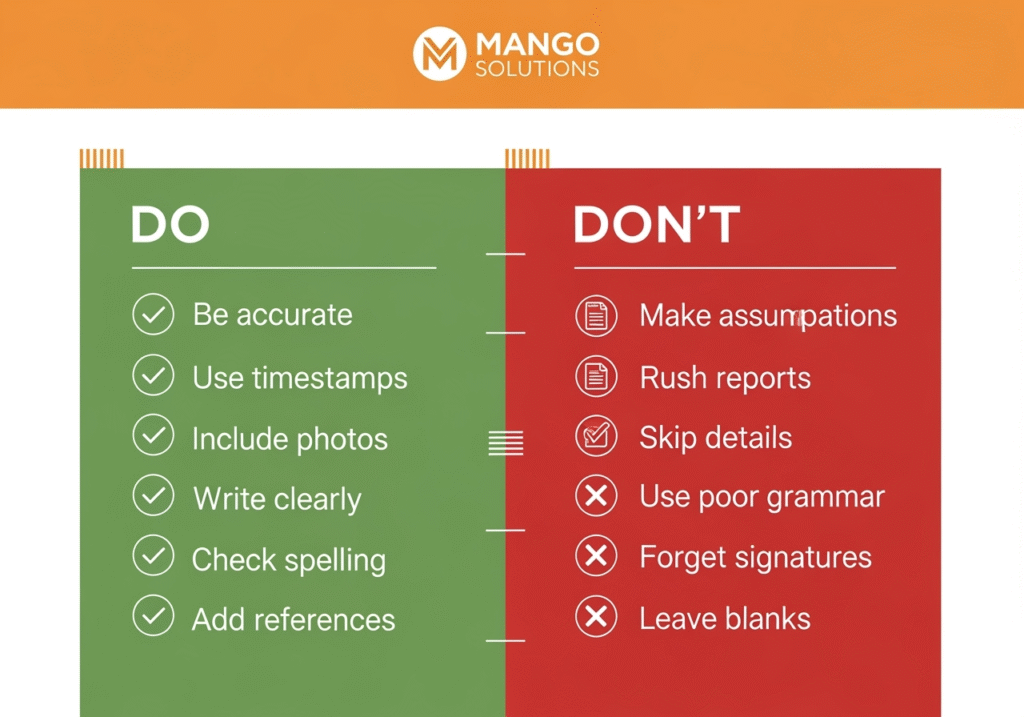
Accuracy: The Non-Negotiable Standard
Accuracy forms the bedrock of every professional security report. In legal proceedings, insurance investigations, or police inquiries, even minor discrepancies can undermine the credibility of an entire incident response. Security professionals must understand that their reports may be scrutinised months or years after the original incident, often by individuals with no knowledge of the circumstances or context.
Accurate reporting begins with precise timekeeping. Every security report should include exact times for key events: alarm activation, dispatch notification, arrival on scene, completion of initial assessment, any escalations or additional responses, and final departure. These timestamps create an indisputable timeline that supports both the security provider’s response performance and the client’s insurance or legal position.
Location details require equal precision. Rather than noting “rear of building,” professional reports specify “rear loading bay, approximately 15 metres from the northwest corner of the main warehouse structure.” This level of detail proves invaluable when insurance assessors need to understand exactly where an incident occurred or when police investigators require precise scene information.
Objectivity: Separating Facts from Assumptions
Professional security reporting demands strict adherence to factual observation rather than subjective interpretation. Security personnel must distinguish clearly between what they observed directly, what they were told by others, and what they concluded based on available evidence.
For example, discovering an open window doesn’t automatically indicate a break-in attempt. A professional report would document: “Ground floor window on east elevation found in open position, approximately 30cm gap. No visible damage to window frame or locking mechanism observed. No signs of disturbance to items visible through window.” This factual approach allows readers to draw their own conclusions whilst providing comprehensive information for decision-making.
The distinction between observation and assumption becomes particularly crucial when dealing with potential criminal activity. Security officers should document what they see, hear, and experience without speculating about motives, identities (unless confirmed through identification), or legal implications. This approach protects both the security provider and the client from potential legal complications whilst ensuring reports remain credible and professional.
Completeness: Leaving No Stone Unturned
Comprehensive reporting means capturing every relevant detail, even those that might seem insignificant at the time. Insurance companies, in particular, rely heavily on thorough documentation to process claims efficiently and accurately. Missing information can delay settlements, reduce payouts, or even result in claim denials.
A complete security report addresses six fundamental questions: Who, What, When, Where, Why, and How. However, professional security reporting extends beyond these basics to include environmental conditions, witness information, photographic evidence, reference numbers from other agencies, and follow-up actions required.
Environmental conditions often prove more significant than initially apparent. Weather conditions, lighting levels, and ambient noise can all impact incident development and response effectiveness. A break-in attempt during heavy rain might leave different evidence patterns than one occurring in dry conditions. Poor lighting might explain why certain details weren’t observed, whilst good illumination might support the reliability of witness descriptions.
The Critical Role of Reports in Legal Proceedings
When security incidents escalate to legal proceedings, professional reports often serve as the primary evidence source for establishing timelines, demonstrating due diligence, and supporting insurance claims. Courts, solicitors, and insurance investigators rely heavily on contemporary documentation created by trained security professionals who witnessed events firsthand.
Supporting Police Investigations
Police officers responding to security-related incidents frequently arrive after the immediate threat has passed. Their investigation depends significantly on information provided by security personnel who were first on scene. A well-structured security report can provide police with crucial details that might otherwise be lost or forgotten.
Professional security reports support police investigations by documenting the scene condition upon arrival, any changes made during the security response, witness statements or observations, and potential evidence that might require specialist examination. This information helps police understand the incident timeline and focus their investigation effectively.
Reference numbers prove particularly valuable in police liaison. When security reports include police incident numbers, insurance claim references, and internal case identifiers, they create clear audit trails that facilitate information sharing between agencies. This professional approach often results in more effective investigations and demonstrates the security provider’s commitment to supporting law enforcement.
Insurance Claim Support
Insurance companies process thousands of claims annually, relying on documentation quality to determine claim validity and settlement amounts. Security reports often provide the most detailed and immediate account of incidents, making them invaluable for insurance assessments.
Effective insurance support requires security reports to address specific elements that insurers routinely examine. These include precise loss descriptions, security measures in place at the time of incident, response timelines demonstrating due diligence, photographic evidence of damage or loss, and witness information that might support or challenge claim details.
The financial implications of thorough reporting cannot be overstated. Insurance settlements can be significantly impacted by the quality of supporting documentation. A comprehensive security report that clearly demonstrates professional response and thorough investigation can mean the difference between full claim settlement and reduced payouts due to perceived negligence or inadequate security measures.
Client Handovers: Building Trust Through Transparency
Client handovers represent one of the most visible aspects of security service delivery. How security personnel communicate incident details to clients often determines the ongoing relationship quality and client satisfaction levels. Professional reporting skills directly translate into confident, credible client communications that reinforce the value of security services.
Immediate Verbal Communications
Whilst written reports provide comprehensive documentation, immediate verbal communications with clients require equal professionalism and accuracy. Security personnel should prepare for client conversations by reviewing their observations, organising information logically, and anticipating likely questions.
Effective verbal reporting follows a structured approach: immediate situation summary, detailed incident description, actions taken by security personnel, current site status, and recommended follow-up actions. This structure ensures clients receive complete information whilst demonstrating the security provider’s professional competence and thorough response.
Client communications should always be supported by reference to written documentation. Phrases like “as detailed in our incident report” or “reference number MS2024-1127” demonstrate systematic approach and provide clients with confidence that incidents are being managed professionally and comprehensively.
Written Client Reports
Written client reports serve multiple purposes beyond simple incident notification. They demonstrate professional standards, provide documentation for client internal processes, support insurance claims, and create records for future security planning. The quality of these reports directly impacts client perceptions of service value and professional competence.
Client-focused reports should balance comprehensive detail with readability. Technical security terminology should be explained or avoided in favour of clear, accessible language. However, this simplification must not compromise accuracy or completeness. The goal is to ensure clients fully understand what occurred, how it was handled, and what implications might exist for ongoing security arrangements.
Visual elements can significantly enhance client report effectiveness. Photographs, site plans, and timeline graphics help clients understand incident details and demonstrate the thoroughness of security response. These elements also prove valuable if incidents later require insurance or legal review.
Control Room Operations: Coordinating Multiple Incidents
Control room operators face unique reporting challenges, often managing multiple incidents simultaneously whilst coordinating with field personnel, emergency services, and clients. Their reports must capture not only individual incident details but also the coordination and decision-making processes that ensure effective overall response.
Real-Time Documentation
Control room reporting requires balancing immediate response coordination with accurate documentation. Operators must develop systems that capture essential information without compromising response effectiveness. This often involves using standardised forms, voice recording systems, and collaborative documentation tools that allow multiple personnel to contribute to incident records.
Time management becomes crucial in control room environments. Operators must document key decisions, communications, and observations in real-time whilst maintaining situational awareness across multiple incidents. This requires disciplined approach to information capture and clear understanding of documentation priorities.
Technology plays an increasingly important role in control room documentation. Modern security management systems can automatically capture timestamps, GPS locations, and communication logs, reducing manual documentation burden whilst improving accuracy. However, operators must still provide context, observations, and decision rationale that automated systems cannot capture.
Multi-Agency Coordination
Control room operators frequently coordinate with police, fire services, ambulance crews, and other emergency responders. Their reports must document these interactions accurately, including reference numbers, personnel names, and any instructions or information exchanged.
Inter-agency coordination documentation serves multiple purposes. It provides audit trails for post-incident review, supports insurance and legal processes, and demonstrates professional cooperation with emergency services. This documentation can prove particularly valuable when questions arise about response coordination or decision-making processes.
Professional control room reports should clearly distinguish between information received from different sources. Details provided by field security personnel, emergency service communications, client contacts, and third-party witnesses should be clearly attributed to maintain report credibility and support subsequent investigations.
Technology Integration: Modern Tools for Professional Reporting
Contemporary security reporting increasingly relies on technology integration to improve accuracy, efficiency, and comprehensiveness. From mobile reporting applications to automated timestamp capture, technology tools can significantly enhance report quality whilst reducing administrative burden.
Mobile Reporting Solutions
Smartphone and tablet applications designed for security reporting offer numerous advantages over traditional paper-based systems. These tools can capture GPS coordinates automatically, integrate photographs directly into reports, and ensure consistent formatting across all documentation. Many applications also support voice-to-text functionality, allowing security personnel to document observations whilst maintaining situational awareness.
However, technology integration must not compromise report quality or professional standards. Security personnel must understand that mobile tools are aids to professional reporting, not replacements for thorough observation and clear communication. The fundamental principles of accuracy, objectivity, and completeness remain paramount regardless of documentation method.
Backup systems remain essential even with advanced mobile reporting tools. Equipment failures, connectivity issues, or battery depletion can compromise electronic documentation. Professional security operations maintain alternative reporting methods to ensure incident documentation continues regardless of technical challenges.
Photographic Evidence
Digital photography has revolutionised security reporting by providing immediate, comprehensive visual documentation. However, effective use of photographic evidence requires understanding of legal and professional standards that govern image capture and storage.
Professional security photography should follow systematic approaches that ensure comprehensive scene documentation. Wide-angle shots establish overall scene context, medium shots show specific areas of interest, and close-up images capture detailed evidence. Each photograph should be accompanied by descriptive captions that explain what is shown and why it is significant.
Image integrity remains crucial for legal and insurance purposes. Professional security operations implement policies that prevent image manipulation and ensure chain of custody for photographic evidence. This might include automatic timestamp embedding, secure storage systems, and clear procedures for image sharing with clients and investigators.
Quality Assurance: Maintaining Professional Standards
Consistent report quality requires systematic quality assurance processes that ensure all documentation meets professional standards. This involves training programmes, review procedures, and continuous improvement processes that adapt to changing client needs and industry requirements.
Training and Development
Professional security reporting skills require ongoing development and refinement. Initial training should cover fundamental principles, legal requirements, and company-specific procedures. However, regular refresher training ensures personnel maintain skills and adapt to evolving best practices.
Training programmes should include practical exercises that simulate real incident scenarios. Role-playing exercises, case study analysis, and peer review sessions help security personnel develop confidence and competence in report writing. These activities also provide opportunities to identify common errors and reinforce professional standards.
Feedback mechanisms play crucial roles in skill development. Regular review of completed reports, client feedback analysis, and peer learning sessions help security personnel understand how their documentation impacts overall service delivery and client satisfaction.
Review and Approval Processes
Systematic review processes ensure report quality whilst providing learning opportunities for developing personnel. Senior security professionals should review reports for accuracy, completeness, and professional presentation before client distribution.
Review processes should focus on both technical accuracy and communication effectiveness. Reports might be factually correct but poorly structured or difficult to understand. Effective review identifies these issues and provides guidance for improvement.
Documentation of review processes creates valuable audit trails that demonstrate professional standards and continuous improvement commitment. This documentation can prove valuable during client reviews, insurance investigations, or regulatory inspections.
Industry Standards and Regulatory Compliance
The security industry operates within complex regulatory frameworks that impact reporting requirements and professional standards. Security providers must ensure their documentation practices comply with relevant legislation whilst meeting industry best practices.
Data Protection and Privacy
Security reports often contain personal information, CCTV footage, and sensitive client details that require careful handling under data protection legislation. Professional security providers implement comprehensive policies that govern information collection, storage, and sharing whilst ensuring operational effectiveness.
GDPR compliance requires particular attention to data minimisation, purpose limitation, and individual rights. Security reports should contain only information necessary for legitimate security purposes, and retention periods should align with legal requirements and business needs.
Privacy considerations extend beyond legal compliance to professional ethics. Security personnel must balance comprehensive documentation with respect for individual privacy rights. This might involve redacting personal details from reports shared with multiple parties or implementing secure sharing systems that control access to sensitive information.
Professional Standards
Industry bodies and professional associations establish standards that guide security reporting practices. These standards reflect collective industry experience and provide frameworks for consistent, professional documentation across different organisations and sectors.
Professional standards often address specific technical requirements such as report formatting, information categories, and quality assurance processes. However, they also encompass broader professional values such as integrity, objectivity, and client service that should underpin all security activities.
Compliance with professional standards demonstrates commitment to industry best practices and can provide competitive advantages in client procurement processes. Many clients now specify adherence to particular standards as requirements in security service contracts.
The Business Case for Excellent Reporting
Professional security reporting delivers measurable business benefits that extend far beyond simple incident documentation. These benefits include reduced insurance costs, improved client retention, enhanced legal protection, and increased operational efficiency.
Client Retention and Satisfaction
High-quality reporting directly impacts client satisfaction by demonstrating professional competence, attention to detail, and commitment to service excellence. Clients who receive comprehensive, timely, and professional incident reports develop confidence in their security provider’s capabilities and value proposition.
Professional reporting also supports client internal processes by providing documentation that meets their insurance, legal, and operational requirements. This reduces administrative burden for clients whilst ensuring they have necessary information for decision-making and compliance purposes.
The cumulative effect of consistent, professional reporting often proves decisive during contract renewal discussions. Clients who have experienced the benefits of comprehensive documentation are more likely to recognise the value of professional security services and less likely to consider cheaper alternatives that might compromise on service quality.
Risk Management and Legal Protection
Comprehensive reporting provides crucial protection against legal challenges, insurance disputes, and regulatory investigations. Professional documentation demonstrates due diligence, supports decision-making rationale, and provides evidence of appropriate response to incidents.
Legal protection extends beyond individual incident documentation to encompass overall service delivery standards. Consistent, professional reporting demonstrates systematic approach to security service delivery that can support defence against negligence claims or service quality challenges.
Insurance benefits include reduced premiums, improved claim settlement rates, and enhanced coverage options. Insurance providers recognise that professional security services with comprehensive reporting practices represent lower risks and often provide preferential terms accordingly.
Future Trends in Security Reporting
The security industry continues to evolve rapidly, driven by technological advancement, changing client expectations, and regulatory developments. Professional security providers must anticipate these trends and adapt their reporting practices accordingly.
Artificial Intelligence and Automation
AI technologies increasingly support security reporting through automated incident detection, natural language processing, and predictive analytics. These tools can identify patterns in incident data, suggest report improvements, and automate routine documentation tasks.
However, AI integration must complement rather than replace human judgment and professional expertise. Security personnel remain essential for contextual understanding, ethical decision-making, and client relationship management that technology cannot replicate.
Professional development must therefore encompass both traditional reporting skills and emerging technology capabilities. Security personnel who can effectively combine human insight with technological tools will deliver superior service quality and professional value.
Integration and Interoperability
Future security reporting will increasingly integrate with client systems, emergency service platforms, and regulatory databases. This integration promises improved efficiency, reduced duplication, and enhanced information sharing across stakeholders.
Interoperability requires standardisation of data formats, communication protocols, and quality standards across different organisations and systems. Professional security providers must participate in these standardisation efforts whilst maintaining competitive advantages through service quality and innovation.
Conclusion: Your Professional Legacy
Every security report you write contributes to your professional legacy and the reputation of the security industry as a whole. Professional, comprehensive, and accurate reporting demonstrates that security services provide genuine value beyond simple physical presence or alarm response.
The investment in developing excellent reporting skills pays dividends throughout security careers and across entire organisations. Clients recognise and value professional competence, colleagues respect thorough documentation practices, and career advancement often depends on demonstrated ability to communicate effectively and professionally.
At Mango Solutions, we’ve built our reputation on the foundation of professional excellence in every aspect of service delivery. Our comprehensive reporting practices have supported clients through complex insurance claims, provided crucial evidence in legal proceedings, and demonstrated the tangible value of professional security services during budget reviews.
The security industry’s future depends on professionals who understand that effective reporting is not an administrative burden but a core competency that defines service quality and professional standards. Every incident report, client communication, and documentation decision